
· by Michael Blair, Nashville's Pool & Spa
A pool deck is the part of the project people walk on barefoot and wet every day of the season, and it is also the part that decides where splash-out and rainwater go. Whether it is poured with a new pool or torn out and rebuilt around an old one, the decisions are the same: what the surface is made of, how it grips when wet, which way it drains, and how it meets the coping at the water’s edge. Around Nashville and Brentwood, add clay soil that swells and shrinks under the slab and a long humid season that keeps shaded stone damp. This is how we work through each piece on our pool construction jobs and on deck replacements done as part of pool renovation.
Concrete, pavers and travertine underfoot
Broom-finished concrete is a poured slab with a stiff broom dragged across it while it sets, leaving fine ridges that give bare feet something to hold. It is one continuous surface, so there are no joints for weeds or ants, but concrete cracks where it wants to unless control joints are cut to tell it where. On our clay, a slab poured over a poorly compacted base will find those cracks sooner. Upkeep is a wash and, if the slab is sealed, a fresh coat of sealer when the old one wears; a sealer built up too thick makes the surface slicker than the bare broom finish was.
Pavers are individual units laid on a compacted base and a layer of bedding sand. The joints let the deck flex a little without cracking, and a paver that settles or lifts can be pulled and reset instead of patched. They only stay put if the edges are held. The CMHA’s tech note on edge restraints says restraints are required along the perimeter of interlocking concrete pavements and where the pavement material changes, that soil backfill is never a suitable restraint, and that restraints should never sit on top of the bedding sand. Joint sand washes out over time and needs topping up, which is the main chore with pavers.
Travertine is a natural limestone with small pits and voids in its face, either filled at the quarry or left open in tumbled pieces. It has a soft, slightly textured feel underfoot that people like around a pool. Being limestone, it is etched by acidic cleaners, so it is cleaned with products made for natural stone and usually sealed. In shade it holds moisture longer than concrete, and a north-facing travertine deck under trees will want more frequent cleaning to keep mildew off.
Grip when wet, and where the water goes
Swimming pool codes ask two things of the walking surface. The text of the International Swimming Pool and Spa Code as Phoenix adopted it, Section 306.2 on UpCodes, says decks, ramps, coping and similar step surfaces shall be slip resistant and cleanable. For tile, there is a measured number to ask about. Crossville’s guide to DCOF ratings explains that the ANSI A326.3 Interior Wet category needs a wet DCOF of 0.42 or greater, and that the Interior Wet Plus category, which lists interior pool decks, and the Exterior Wet category call for an elevated rating. An outdoor pool deck is an exterior wet area, so any tile or porcelain paver we put there carries a rating for that use, not just the interior one.
Slope matters as much as texture. The same Phoenix code text, in Section 306.5, limits the slope of decks other than wood to no more than 1/2 inch per foot and requires that standing water be no deeper than 1/8 inch 20 minutes after the water stops. Those are Phoenix’s adopted figures, not Nashville’s, but they describe what a well-built deck does anywhere: it sheds water quickly without being steep enough to feel tilted.
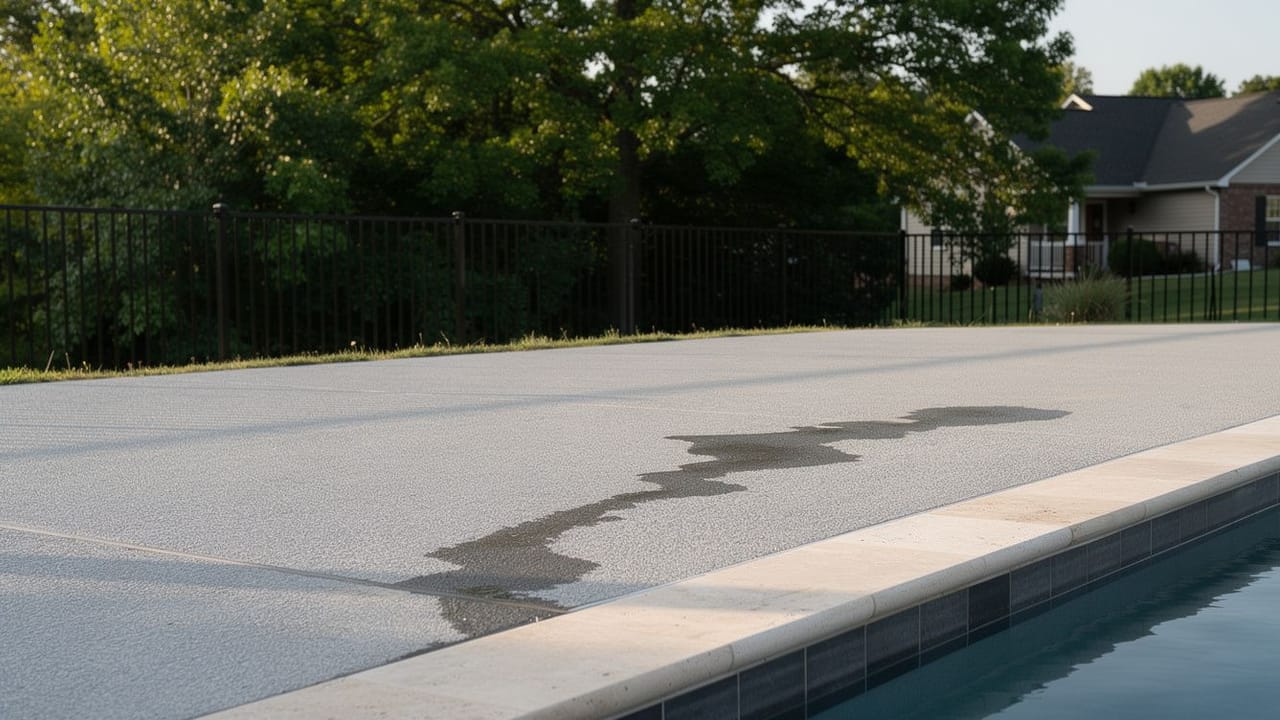
We pitch the deck away from the pool. Water that runs back into the pool carries grass clippings, mulch, fertilizer and dirt off the yard and into the chemistry. Water that sits along the outer edge of the slab soaks into clay that then swells and lifts that edge. Where the yard slopes toward the pool or the house, the answer is a channel drain or area drains piped to daylight, so the deck has somewhere to send water other than the pool or the foundation.
- Pitch away from the water, toward a drain or open lawn
- No low spots where a puddle stays after a swim
- Tile and pavers rated for exterior wet use
- Sealers that do not leave a glossy film on a walking surface
Where the deck meets the coping
Coping is the cap along the top of the pool wall, the edge swimmers grab and the first thing they step on climbing out. It can be precast concrete, travertine, a bullnosed paver or a poured edge that runs out from the deck itself. Its job is to cover the top of the pool’s bond beam and turn the deck’s water away from the gap behind the pool wall.
The pool shell and the deck are two different structures. The shell is a heavy, reinforced basin; the deck is a thinner slab or a paver field resting on soil that moves with the seasons. If the deck is poured tight against the coping with nothing between them, every movement in the deck pushes on the coping, and over a few years that shows up as cracked coping stones, coping that rocks loose, or cracked tile at the waterline below it. So the deck is separated from the coping by a joint filled with a flexible sealant, which lets the two move independently and keeps water out of the gap. When that sealant dries out and splits, it gets cut out and replaced; it is routine maintenance, like caulk around a tub.
A deck replacement is the cheapest time to deal with the coping, because the deck around it is already gone. If the coping is loose or the waterline tile is cracking, it is worth looking at the interior finish while the pool is opened up; our post on when a pool needs resurfacing covers what we look for.
The barrier, the alarm and the permit
A new deck changes the space inside the fence, and the fence still has to do its job when the work is done. Metro’s residential building permit procedures state that below or above ground pools require a 48 inch high barrier or fence around the pool. A wider deck that pushes into the fence line, a gate that gets moved for equipment access, or a fence panel removed during demolition are all barrier questions, and we plan the job so the barrier is whole before the pool is used again.
For a new pool in Davidson County, Metro Codes’ residential pool permitting instructions list what goes in with the application, including a receipt for a pool alarm under Tennessee Code § 68-14-804, and they point to the International Swimming Pool Code for the barrier and fencing requirements. We handle that permit as part of the build. Whether a deck replacement on an existing pool needs its own permit depends on what changes, so we check with the building office for that address before the old deck comes out.
Brentwood, Franklin and the rest of Williamson County are outside Metro, and their own building departments set the process there; the pool and spa work we do in Brentwood starts with that same check. For the safety pieces that sit beyond the fence itself, alarms, covers and what a deck layout does for supervision, see pool safety beyond the fence.
Sources
- Metro Nashville Codes, Residential Building Permit Procedures — Pools require a 48 inch high barrier or fence around the pool.
- Metro Nashville Codes, Residential Pool Permitting Instructions — Pool alarm receipt under Tennessee Code § 68-14-804; barrier requirements in the International Swimming Pool Code.
- UpCodes, Phoenix Swimming Pool and Spa Code, Chapter 3 (Sections 306.2 and 306.5) — Decks slip resistant and cleanable; slope and standing-water limits as adopted in Phoenix.
- Concrete Masonry & Hardscapes Association, Tech Note PAV-TEC-003, Edge Restraints — Edge restraints required at the perimeter of interlocking pavements; soil backfill is never suitable.
- Crossville, Porcelain Tile DCOF Ratings and Applications — ANSI A326.3 Interior Wet requires wet DCOF of 0.42 or greater; Interior Wet Plus and Exterior Wet are elevated.