
· by Michael Blair, Nashville's Pool & Spa
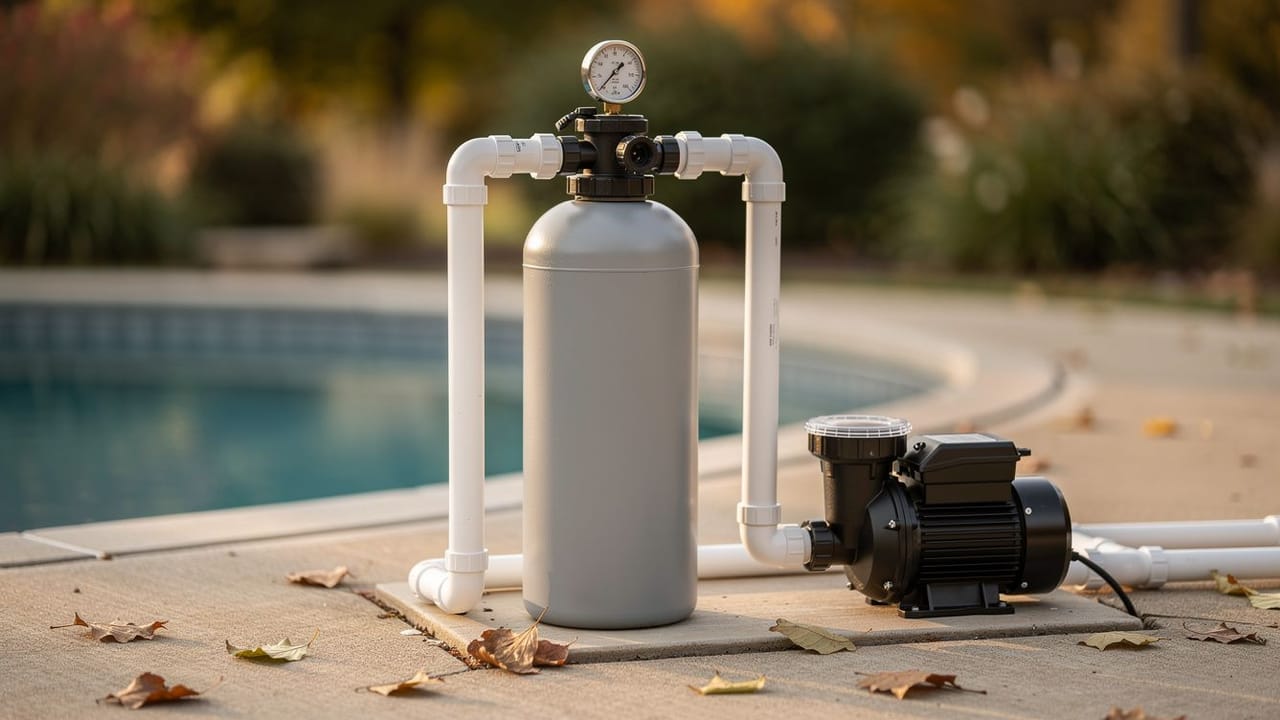
The small round gauge on top of a pool filter is the cheapest piece of test equipment on the pad and the one most often ignored. Its number on its own says little. What matters is how far it has climbed since the filter was last clean, and the two big filter makers each print that distance in their manuals. This post is about cartridge filters, which those manuals cover; a sand or DE filter has its own number in its own manual.
What does the pool filter pressure gauge tell you?
It tells you how much dirt the cartridge is holding, by comparison with what it read when clean. Hayward’s SwimClear cartridge filter owner’s manual explains that as dirt builds up in the elements, the gauge pressure rises and the flow falls. Pentair’s Clean & Clear RP filter guide calls the clean reading the original starting pressure and gives a table in the manual for writing it down, and Hayward’s gauge carries a green arrow you move to the clean reading.
Pentair adds a catch that matters on a lot of pads. With a variable-speed pump, the starting pressure depends on the pump’s speed, so the manual asks you to record the RPM along with the pressure. A reading taken at another speed is not comparable; our post on single-speed and variable-speed pumps covers the pump side of that.
Both manuals also list 50 psi as the maximum working pressure for the filters they cover, so the gauge is a limit as well as a cleaning reminder.
How many psi above clean pressure is too many?
Pentair says 8 to 10 psi; Hayward says 7 to 10. Pentair’s manual says to clean the filter when the gauge reads 8 to 10 psi above the original starting pressure, or when flow drops noticeably. Hayward’s says to clean or replace the elements when pressure is 7 to 10 psi above the starting pressure, or when flow falls below the rate you want. The ranges overlap but are not the same, so go by the manual for the filter you own rather than a number from someone else’s.
Pentair notes that how fast the pressure climbs depends on bather load, temperature and conditions around the pool, so there is no fixed number of weeks between cleanings; the gauge sets the schedule. Hayward builds that into the gauge itself, with a second, red arrow marking the cleaning point.
Hayward also says when cleaning stops being enough. If the starting pressure right after a cleaning is more than 6 psi above what it was with new elements, it says to replace the elements the next time the gauge reaches the red arrow. That makes the reading from the day the cartridges were new worth keeping.
How do you clean a pool cartridge without damaging it?
With a garden hose, inside and out, and no pressure washer. Pentair’s guide says to wash the inside and the outside of the cartridge with a garden hose. Hayward says to hose the elements inside and out and brush the pleats, and it says plainly not to pressure wash them, because that can damage the element.
Once the cartridge is back in and the pump is running at its usual speed, the new reading is the one to compare with the reading you took when the elements were new. That comparison is Hayward’s replacement test, and it tells you whether the cleaning brought the cartridge back or whether its time is nearly up.
What a weekly visit writes down
On our weekly pool service, the filter is backwashed or cleaned as part of the visit and readings are recorded rather than guessed. The filter pressure belongs in that record next to the chemistry, with the pump speed it was taken at, because one reading tells you little and a run of them shows the climb.
If you look after the pool yourself, the habit is the same: write down the clean pressure and the pump speed after each cleaning and look at the gauge each week. A gauge that sticks or will not read at all is worth replacing, since the whole method depends on it, and that falls under our equipment repair. For pools in Franklin and across Williamson County, or anywhere else we serve, ask us about weekly service.
- Record the clean starting pressure, and the pump RPM on a variable-speed pump (Pentair)
- Pentair: clean at 8 to 10 psi above the starting pressure
- Hayward: clean at 7 to 10 psi above the starting pressure
- Hayward: replace the elements if the clean reading is more than 6 psi above the new-element reading
- Hose inside and out and brush the pleats; never pressure wash (Hayward)
- Maximum working pressure in both manuals: 50 psi
Sources
- Pentair, Clean & Clear RP Cartridge Filter Installation and User’s Guide — Clean at 8 to 10 psi above the original starting pressure or on reduced flow; buildup varies with bather load, temperature and conditions; record RPM with a variable-speed pump; garden hose inside and out; 50 psi maximum
- Hayward, SwimClear Cartridge Filter Owner’s Manual (ISC2031EF Rev B) — Pressure rises and flow falls as dirt builds; clean at 7 to 10 psi above starting pressure; green and red gauge arrows; replace elements past 6 psi over new; hose and brush, do not pressure wash; 50 psi maximum
FAQ
Reading the Pool Filter Pressure Gauge — questions
What should my pool filter pressure be?
There is no single right number; it is whatever your filter reads when the cartridge is clean, at your pump’s normal speed. Write that starting pressure down. Pentair says to clean when it climbs 8 to 10 psi above it, Hayward 7 to 10. Both manuals list 50 psi as the maximum working pressure.
When should I clean my pool cartridge filter?
When the gauge has risen far enough above the clean starting pressure, or the flow drops noticeably. Pentair’s Clean & Clear RP manual puts that at 8 to 10 psi above; Hayward’s SwimClear manual puts it at 7 to 10. Use the figure in the manual for the filter you actually own.
Why is my pool filter pressure high?
The manuals’ answer is dirt: Hayward explains that as dirt builds up in the cartridge, the gauge pressure rises and the flow falls. Compare the reading with the clean starting pressure you recorded. If it is 7 to 10 psi higher on a Hayward, or 8 to 10 on a Pentair, clean the cartridge.
How do I find my pool filter starting pressure?
Read the gauge right after the cartridge has been cleaned or replaced, with the pump running at its normal speed. Pentair’s manual has a table for writing it down, along with the RPM on a variable-speed pump, and Hayward’s gauge has a green arrow you move to that reading.
Can I pressure wash a pool filter cartridge?
Hayward’s SwimClear manual says no, because a pressure washer can damage the element. It says to hose the cartridge inside and out and brush the pleats instead. Pentair’s manual likewise calls for a garden hose on the inside and outside of the cartridge, so a hose is what both makers expect.
How often should a pool cartridge filter be cleaned?
As often as the gauge says, not on a calendar. Pentair notes that the rate of buildup depends on bather load, temperature and conditions around the pool. Clean when the pressure is 8 to 10 psi over the starting reading on a Pentair, or 7 to 10 over it on a Hayward.